Refractive errors
Blurry focus at near or far?
Nearsightedness, farsightedness, and astigmatism can affect the way your eyes focus. An assessment helps determine whether a prescription may help.
Nabua & Naga City
Personal, doctor-led care
CAM SUR EYE CENTER
Understand your focus
Eye care for your everyday life.
The essentials
Start with these key points
- A refractive error affects how light focuses in the eye.
- A prescription check measures correction; an eye health examination checks for other concerns.
- Tell the clinician which tasks and distances matter most to you.
What are refractive errors?
Refractive errors occur when light does not focus clearly on the retina. They include nearsightedness, farsightedness, astigmatism, and age-related difficulty focusing close up. More than one can affect the same person. 1
Understanding the common types
Myopia: nearsightedness
Distant objects are blurred. Close tasks may be easier. 2
Hyperopia: farsightedness
Near work can be difficult, and some people also notice distance blur. 1
Astigmatism
The way the eye focuses can cause blur or distortion at different distances. 1
Presbyopia
With age, the eye becomes less able to focus on nearby objects, making small print more difficult. 1
Symptoms worth describing
Blur, squinting, headaches, or eye strain during visual tasks can be reasons to arrange a check. These symptoms do not prove that a glasses prescription is the only issue. 1
Be specific about the task: reading a phone, looking at a computer, seeing a classroom board, or recognizing road signs. Mention when the problem started and whether your current glasses help.
What happens during the assessment
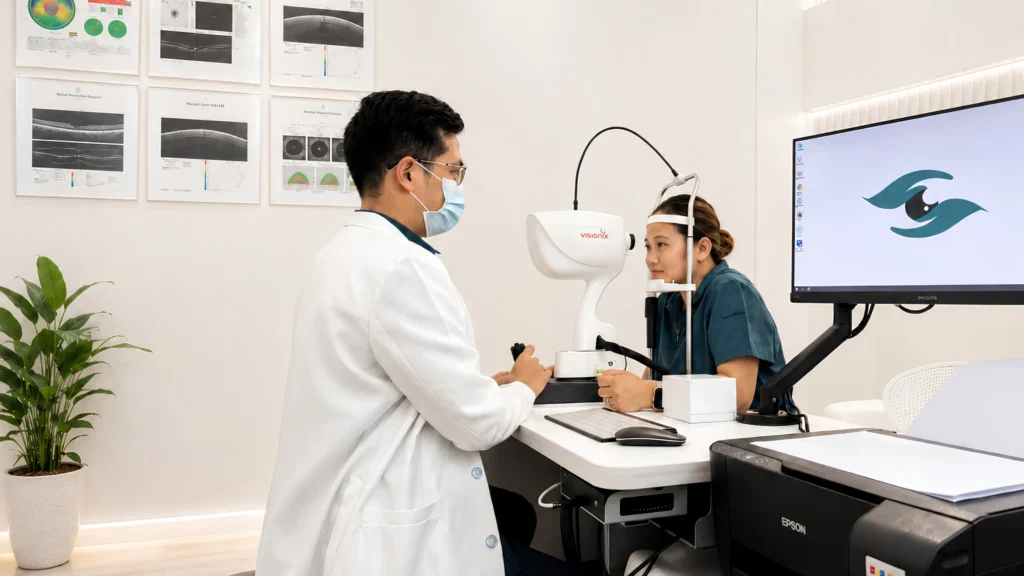
Vision testing and refraction help determine a suitable prescription. The clinician may ask you to compare lenses and say which looks clearer. An eye health examination considers other causes of the symptoms. 1
Take your time answering; tell the examiner if two choices look the same. Bring all glasses you use, including reading or work pairs, and explain any difficulty switching between them.
Choosing correction that fits your day
Glasses are a common way to correct refractive error. Contact lenses or refractive surgery may be options for some people after a suitability assessment. 3
Discuss your work distances, comfort, previous prescription, and budget. Ask what the proposed lenses are designed to help with and whether you may need separate correction for different tasks. This guide does not imply that every correction option is offered at the clinic.
Before ordering, request the full estimate and clarify the frame, lenses, collection arrangements, and whom to contact if you have difficulty with the new pair.
When it involves a child
If a child struggles to see the board or holds reading material unusually close, arrange a vision assessment. Myopia often starts in childhood. 2
Tell the clinician about school observations and previous prescriptions. Ask whether the child needs an eye health assessment, how the prescribed glasses should be used, and when vision should be reviewed. Do not choose a prescription from another family member’s experience.
Why correction matters in the Philippines
Uncorrected refractive error was one of the causes of visual impairment identified in the 2018 Philippine Eye Disease Study. These national findings are historical, not a current local prevalence estimate. 4
A practical next step is to bring your current glasses and a list of the tasks you want to see more comfortably. Your own examination determines what correction, if any, is needed.
When to seek urgent care
Sudden vision loss, new flashes or floaters, a curtain-like shadow, or severe pain should not be treated as simply needing new glasses. Seek urgent eye assessment.
Questions to take to your appointment
- What does my prescription mean for distance and near work?
- Were there any eye health findings beyond the prescription?
- Which lens option fits my usual tasks and budget?
- When should I return if the new glasses are difficult to use?
Frequently asked questions
Is refraction the same as a complete eye examination?
No. Refraction measures optical correction. Ask what is included in your visit and whether your symptoms or history call for additional eye health checks.
Should I order glasses from an old prescription?
Ask whether it is still appropriate, especially if your vision or comfort has changed. Bring the previous prescription so it can be compared.
Do reading glasses address every kind of blur?
No. Describe which distances are difficult and whether the two eyes feel different. The assessment helps identify the appropriate next step.
What if my new glasses feel wrong?
Contact the provider that assessed and supplied them. Explain the task and distance that are difficult, and ask whether the fit or prescription needs review. Sudden or painful changes need urgent care.
Your feedback matters
Is this article helpful?
Your answer helps us understand what readers find useful.
Keep reading